Energy healing is one of those phrases that can feel either deeply inviting or completely out of reach, depending on who you hear it from. Some people encounter it through a Reiki session, a yoga class, or a friend who swears by the crystal on her nightstand. Others see it on social media and wonder if it is only for people who already understand chakras, auras, and frequencies.
Here is the truth: energy healing is a personal practice, not a professional credential. It is the act of working with your own energy, your own body, and your own intention in a way that supports your overall sense of wellbeing. It is not a medical treatment, and it does not replace professional healthcare. But as a personal practice, it is something anyone can explore at home, starting today, with no special training required.
This guide is for the absolute beginner. If you have never held a crystal, never meditated, never lit a candle with intention, you are in the right place. We will walk through what energy healing actually is, how to set up a small space in your home, how to choose your first tool, and how to build a simple daily practice that takes ten minutes or less.
What Is Energy Healing?
At its simplest, energy healing is the practice of working with the subtle energy that many traditions believe flows through and around the human body. Different cultures use different names for it: qi in Chinese medicine, prana in Ayurveda, ki in Japanese traditions. The core idea is shared across thousands of years and dozens of cultures: there is a life force that moves through all living things, and when that energy flows freely, you feel more balanced, grounded, and at ease.
Energy healing does not require you to believe anything in particular. It asks you to pay attention. To slow down. To notice how your body feels when you hold a piece of copper in your hands, or sit quietly with a crystal on your lap, or place an orgonite pyramid on the table in front of you and breathe. The experience is personal, and what you notice is yours. There is no wrong answer.
Many practitioners describe the experience as a sense of warmth, tingling, heaviness, or calm. Others notice nothing physical at all and simply find that they feel more centered after ten minutes of quiet practice. Energy healing is not a promise of results. It is an invitation to pay attention.
Do You Need Special Abilities?
No. This is the most important thing a beginner needs to hear. You do not need to be gifted, sensitive, psychic, or born into a lineage. You do not need to see auras or feel vibrations in your hands. Energy healing as a personal practice is available to everyone. It is as natural as sitting still and breathing, which is literally how most practices begin.
Some people are drawn to energy healing because they feel something they cannot explain. Others approach it purely as a way to slow down in a world that runs at full speed. Both are valid starting points. The only requirement is curiosity.
Setting Up Your Space
You do not need a meditation room. You do not need candles, incense, or ambient music (though you are welcome to include any of those if they help you settle in). All you need is one quiet corner where you can sit undisturbed for ten minutes.
Here is what works for most beginners:
- A comfortable seat: A chair, a cushion on the floor, or the edge of your bed. Anywhere you can sit upright without strain.
- A small surface nearby: A nightstand, a side table, or even the floor beside you. This is where you place your tools during practice.
- Minimal distractions: Phone on silent, door closed if possible. The practice works better when your attention is not divided.
- Consistency: The same spot each day helps your mind and body associate the space with stillness. It does not need to be special. It just needs to be yours.
Some practitioners set up a small dedicated area over time: a shelf with their tools, a sacred geometry print, a few crystals, a journal. But that comes later. For now, a chair and a flat surface are enough.
Choosing Your First Tool
You can practice energy healing with nothing at all. Your hands, your breath, and your attention are the foundation. But many beginners find that a physical tool gives them something to focus on, something to hold, something to anchor the practice in the physical world. It turns an abstract concept into something you can touch.
Here are four types of tools that practitioners commonly use, each serving a different purpose. You do not need all of them. Start with one.
Orgonite Pyramids: The Home Anchor
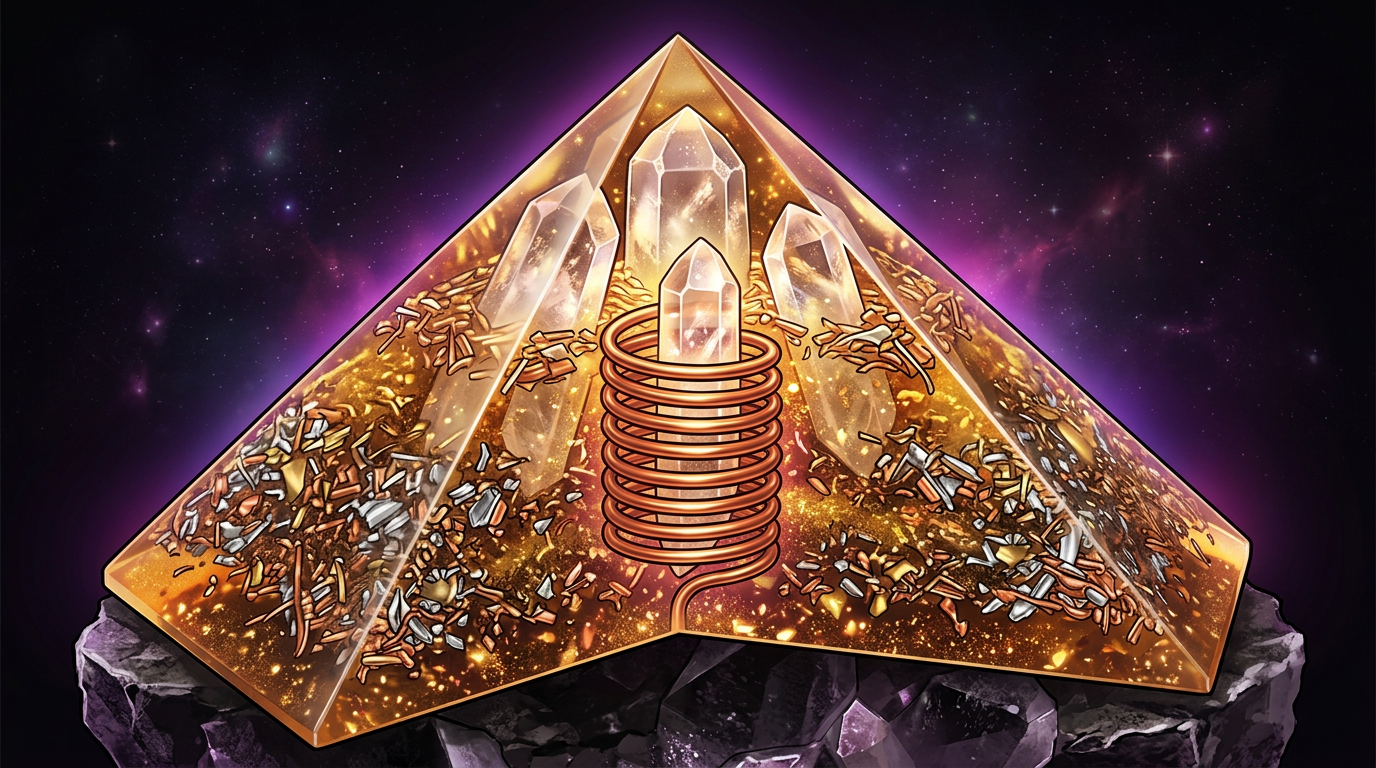
An orgonite pyramid sits on a surface and stays there. It becomes the center of your practice space. Within the energy healing tradition, the combination of metal shavings, crystal, and resin inside the pyramid is believed to interact with the energy of the room. Many practitioners report a sense of calm, deeper sleep, and clearer focus when working near an orgonite pyramid. The Small Orgonite Pyramid ($100) is the most popular first tool for home practitioners. Every piece is handcrafted in Michelle's Maine studio. For a deeper look at how practitioners work with these tools, read our guide to orgonite pyramid benefits. For room-by-room placement ideas, see the orgonite pyramid placement guide.
Tensor Rings: The Affordable Entry Point
A tensor ring is a loop of copper wire twisted and joined at a specific length. Within the tensor ring tradition, these measurements correspond to frequencies that are believed to create a toroidal energy field. The Half Cubit Tensor Ring ($22) is the most accessible starting point. Hold it in your hands during meditation, place it around a glass of water overnight, or set it on your body during a lying-down practice. Many practitioners report that water left inside a tensor ring tastes noticeably smoother. For a full exploration of what tensor rings are and how to use them, see our tensor ring guide.
Glass Charging Plates: The Crystal Care Essential
If you already work with crystals, or plan to, a Sacred Geometry Glass Charging Plate ($55) serves as both a functional tool and a visual anchor for your practice space. The Flower of Life pattern etched into the plate is one of the oldest sacred geometry symbols, and within the practitioner tradition, it is believed to amplify the energy that flows through it. Place your crystals on the plate overnight to cleanse and recharge them. During practice, set it in front of you as a focal point. For crystal care methods, read our guide on how to charge crystals.
Copper Bracelets: The Wearable Daily Reminder
Wearing copper against the skin is a tradition that stretches back thousands of years. Many practitioners believe copper supports circulation, joint comfort, and energetic balance. The Wire-Wrapped Copper Bracelet ($33) is lightweight enough to wear all day, and it serves as a physical reminder of your practice even when you are not sitting in your quiet corner. Every time you notice it on your wrist, you reconnect to your intention. For more on the tradition, see our copper healing benefits guide.
Michelle's Starter Kit
Three ways to begin, based on your budget. Every piece is handcrafted in Michelle's Maine studio.
Start Simple: $22
Half Cubit Tensor Ring
Hold it, wear it, or place it around water.
Shop Tensor RingsAdd a Surface: $55
Glass Charging Plate
Anchor your space with sacred geometry.
Shop Charging PlatesA Simple 10-Minute Daily Practice
This is not a guided meditation or a structured program. It is a framework. You will adjust it to fit your own rhythm over time. For now, follow these steps as written. They take about ten minutes.
- Sit down in your space. Same spot, same time if possible. Morning works well for most people because the day has not yet filled your head with noise. But any time works.
- Hold your tool or place it in front of you. If you are using a tensor ring, hold it in your lap or in your hands. If you have a pyramid, set it on the surface beside you. If you are using nothing at all, place your hands palms-up on your knees.
- Set one intention. Not a wish, not a goal. An intention. A single word or phrase that represents how you want to feel: grounded, calm, open, clear, strong. Say it once in your mind. Let it settle.
- Close your eyes and breathe. Natural breath. Do not force it deeper or slower. Just notice it. In, out. Let your attention rest on the sensation of breathing.
- Notice what you feel. Warmth in your hands? Heaviness in your chest? Tension in your shoulders? Absolutely nothing? All of those are valid. The practice is the noticing, not the feeling.
- When your mind wanders, return to the breath. It will wander. That is not failure. That is how minds work. Gently come back. No judgment.
- After ten minutes, open your eyes. Take one more breath. Notice how you feel compared to when you sat down. That difference, however subtle, is the practice working.
That is it. Ten minutes. One tool (or no tool). One intention. Repeated daily, this practice builds a foundation that you can expand in any direction: deeper meditation, crystal work, chakra work, Reiki, sound healing, or simply continuing to sit quietly with a piece of handcrafted copper in your hands and ten minutes of peace.
Building from Here
Your first week should be simple. Same spot, same time, same practice. Resist the urge to add more. The goal is consistency, not complexity.
After a week or two, you may notice patterns. You might feel calmer on days when you practice. You might sleep better on nights when you sit with your pyramid before bed. You might find that your tensor ring water tastes different from the tap. These observations are your compass. Follow them.
When you are ready to go deeper, these resources will help:
- Choosing Healing Crystals: a beginner's guide to selecting crystals for different intentions.
- How to Charge Crystals: moonlight, sunlight, sound, and sacred geometry methods.
- Orgonite Pyramid Placement Guide: room-by-room ideas for your home.
- Copper Healing Benefits: the tradition behind wearing and working with copper.
- Sacred Geometry in Energy Healing: patterns, meaning, and how practitioners use them.
Energy healing is not a destination. It is a practice, which means it grows with you. Some days it will feel powerful. Some days it will feel like sitting in a chair for ten minutes. Both count. The only day that does not count is the one you skip entirely.
Frequently Asked Questions
Can anyone do energy healing at home?
Yes. Energy healing as a personal practice does not require certification, special abilities, or prior experience. It is the act of working with your own energy through intention, breathwork, and tools like orgonite pyramids, tensor rings, and crystals. Anyone can begin at home with a quiet space and a few minutes each day. Energy healing is a personal wellness practice and is not a substitute for professional medical care.
What tools do I need to start energy healing?
You can start with nothing at all. Your breath and your attention are the foundation of the practice. Many beginners find that a physical tool helps them focus. A Half Cubit Tensor Ring ($22) is the most affordable entry point. A Glass Charging Plate ($55) works well if you already own crystals. A Small Orgonite Pyramid ($100) is the most popular first tool for home practitioners who want a dedicated anchor for their space.
How often should I practice energy healing?
Daily practice, even as short as ten minutes, produces the most noticeable results over time. Consistency matters more than duration. Many practitioners sit for ten minutes each morning and find that this is enough to establish a rhythm. If daily practice is not realistic, three to four sessions per week is a good starting point. The key is regularity, not perfection.
Is energy healing the same as Reiki?
Reiki is one specific form of energy healing that originated in Japan. It involves channeling energy through the hands, typically from a trained practitioner to a recipient. Energy healing is a broader term that includes Reiki as well as crystal healing, sound healing, chakra work, breathwork, and practices using tools like orgonite, tensor rings, and copper. You can practice energy healing at home without any Reiki training.
What should I expect during my first energy healing session?
Expectations vary widely, and that is normal. Some people feel warmth, tingling, or a sense of heaviness during their first session. Others feel calm but nothing physically remarkable. A few people feel nothing at all during the first several sessions and then begin to notice subtle shifts over days or weeks. There is no right or wrong experience. The practice is about paying attention to what you notice, not achieving a specific sensation.