You have probably felt the power of sound without thinking about it. A song that stopped you mid-step and brought tears you didn't expect. The hum of wind through pines that made everything feel, for a moment, completely still. The way a deep bell tone can make your whole body exhale.
Sound moves through us, literally. It doesn't stop at the skin. And sound healing practitioners have been working with that principle for thousands of years, using instruments like singing bowls, drums, gongs, and tuning forks to bring the body's energy back into alignment.
Tuning fork healing is one of the more focused and precise forms of sound healing. If you have been curious about it, what it is, what happens during a session, and whether it might be for you, let's walk through it together.
What Is Tuning Fork Healing?
Tuning forks were originally created in 1711 as a tool for musicians, a reliable way to produce a pure, consistent tone for tuning instruments. But sound healing practitioners discovered that these same precise frequencies could be applied to the body's energy system.
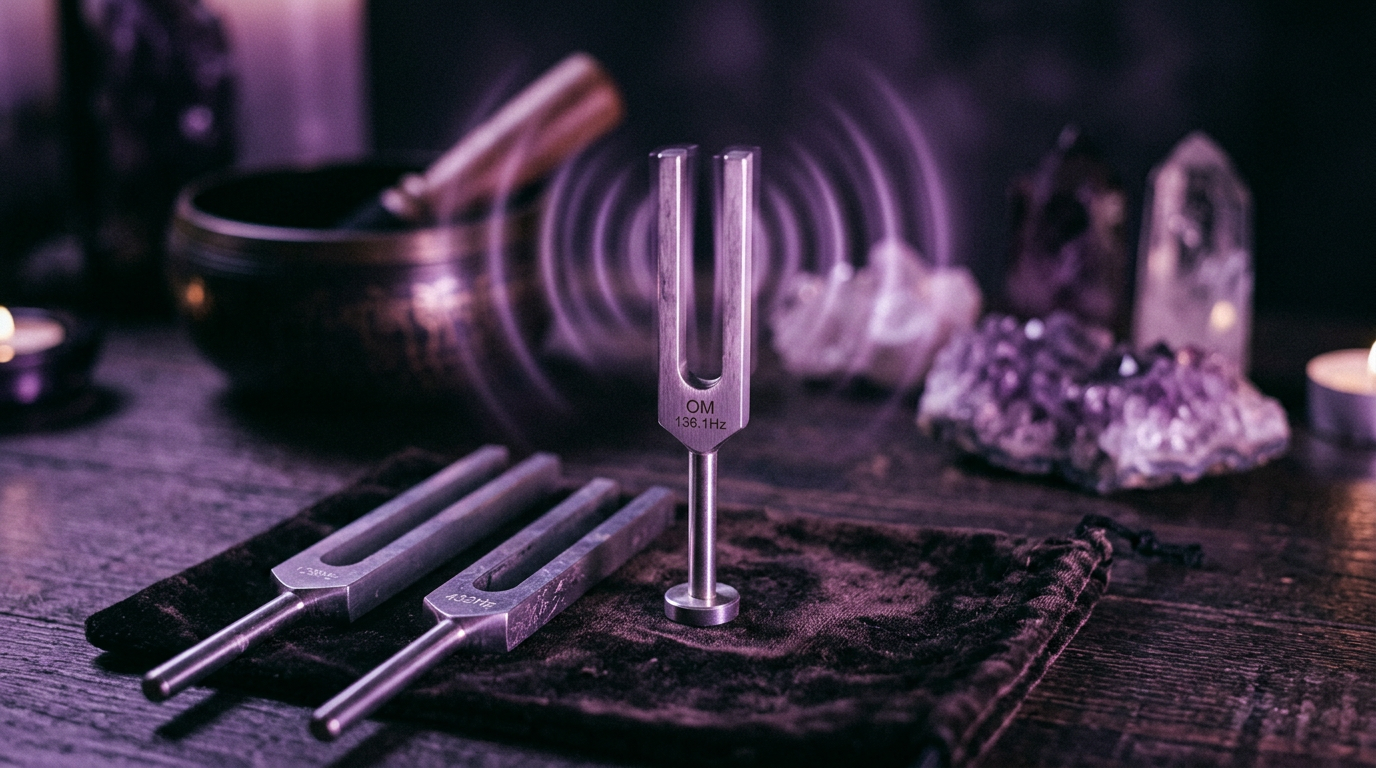
In a tuning fork healing session, a practitioner uses specially calibrated forks, each tuned to a specific frequency, to address areas of energetic imbalance. When a tuning fork is struck and held near the body, it produces a pure vibrational tone that practitioners believe interacts with the body's own energy field.
The underlying principle is straightforward: everything in the body vibrates at certain frequencies. When we are healthy and balanced, these frequencies are in harmony, like instruments in tune. When we are stressed, in pain, or emotionally blocked, certain areas fall "out of tune." Tuning forks are believed to help nudge those areas back toward their natural resonance.
This practice draws from the broader tradition of vibrational medicine, which holds that frequency and vibration play a foundational role in well-being. It is a complementary practice, meant to support your overall wellness, not replace medical care.
What Happens During a Session
If you have never experienced a tuning fork session, here is what you can typically expect:
Before you begin. Most practitioners start with a conversation. They will ask how you are feeling, where you are carrying tension or discomfort, and what your intention is for the session. This isn't just pleasantry. It helps the practitioner understand which frequencies and placements might serve you best.
Setting up. You will usually lie down fully clothed on a massage table or comfortable surface. The environment is intentionally calm: soft lighting, minimal noise, perhaps a grounding scent like cedar or sage. Some practitioners begin with a few deep breaths or a short guided centering to help you arrive in the space.
The forks. The practitioner selects tuning forks based on the frequencies needed. Some common tuning systems include:
- Weighted forks. These have weights on the prongs and produce a lower, more penetrating vibration. They are often placed directly on the body (on acupressure points, along the spine, on joints) so you feel the vibration physically through the bone and tissue.
- Unweighted forks. These produce a higher, more audible tone and are typically held near the body, around the head, or along the energy field (sometimes called the biofield). The sound is the primary vehicle here, rather than direct physical vibration.
During the session. The practitioner moves through different areas of the body, striking forks and listening, both to the tone of the fork and to what they sense in your energy field. Some practitioners report that a fork's tone changes in areas where energy is stuck or blocked, becoming inconsistent or wavering before eventually smoothing out.
Sessions typically last 30 to 60 minutes. Throughout, you simply rest and receive. Many people find their mind quiets naturally as the tones wash over and through them. It is common to feel deeply relaxed, to experience gentle warmth or tingling, or to notice emotions rising and releasing. Some people fall asleep. All of these responses are normal.
After. Most practitioners give you a few minutes to return slowly, to open your eyes, sit up gradually, and reconnect with the room. You might feel calm, grounded, lighter, or slightly dreamy. Drinking water afterward is commonly recommended, similar to post-massage care. Some people notice the effects continuing to unfold over the following hours or days.
What People Report Feeling
Individual experiences vary widely, but here are some of the most commonly described effects:
- Deep relaxation. This is the near-universal response. Even people who are skeptical going in tend to leave feeling notably calmer. The nervous system responds to these frequencies. That is not esoteric; it is observable.
- Reduced physical tension. Areas of chronic tightness, neck, shoulders, lower back, often soften during a session. Practitioners believe the vibration helps release physical holding patterns connected to energetic or emotional stress.
- Emotional release. Don't be surprised if emotions surface. Tears, laughter, a sense of relief: these are all common and welcomed. Practitioners see this as energy moving, not as something going wrong.
- Mental clarity. Many people describe a "fog lifting" sensation after a session. Decisions that felt confusing, anxieties that felt heavy, they sometimes feel more manageable after the body's energy has been addressed.
- Better sleep. Particularly after the first few sessions, improved sleep quality is one of the most frequently reported benefits.
- A sense of alignment. This is harder to articulate but often the most meaningful. People describe feeling "put back together," "more like themselves," or "reconnected to something."
Who Is Tuning Fork Healing For?
The short answer: almost anyone. But certain people tend to find it especially meaningful:
If you carry chronic stress. The kind that lives in your shoulders, disrupts your sleep, and makes you feel like you are running on fumes. Sound healing works with the nervous system in a way that many people find more effective than trying to think their way out of stress.
If you are going through a transition. A move. A loss. A career change. A relationship shift. Life transitions shake up your energy. Tuning fork sessions can help you process and recalibrate when the ground beneath you feels unsteady.
If you feel energetically stuck. You can't always name it, but you feel it: a heaviness, a fog, a sense of being disconnected from yourself. Practitioners believe these are signs of energy blockages, and tuning forks are one of the most direct tools for addressing them.
If you are building a healing practice. Many people who explore tuning fork sessions are already working with crystals, meditation, tarot, or other modalities. Sound healing adds another dimension to that practice, one that works on a vibrational level you can literally feel.
If you are simply curious. That's reason enough. You don't need to have a problem to solve. Sometimes the most powerful sessions are the ones where you simply show up, lie down, and let sound do what sound does.
Sound Has Always Been Medicine
Long before tuning forks, long before recorded history, humans used sound for healing. Chanting, drumming, singing, the rhythmic clapping of hands around a fire. We knew, instinctively, that certain vibrations could shift something inside us.
Tuning fork healing is a modern refinement of that ancient knowing. It is precise where drumming is broad. It is targeted where singing bowls are immersive. And it works quietly: no fanfare, no spectacle. Just frequency meeting the body and the body remembering what balance feels like.
If that resonates with you, even a little, trust that.
Michelle offers tuning fork healing sessions through The Northern Daisy. Book a session at thenortherndaisytarot.com