Some shapes don't just exist. They resonate. You've felt it, even if you've never put a name to it. The spiral of a nautilus shell. The hexagonal lattice of a honeycomb. The way a snowflake unfolds into perfect symmetry, every single time.
Sacred geometry is the study of these patterns: the mathematical relationships and proportions that appear throughout the natural world, from the smallest cell to the largest galaxy. And among all its forms, one shape has captivated builders, seekers, and energy practitioners across thousands of years. The pyramid.
If you've ever held an orgonite pyramid and wondered why it's shaped that way, or why pyramids show up in cultures separated by oceans and millennia, this is where we start.
What Is Sacred Geometry?
Patterns in Nature: Spirals, Hexagons, and the Golden Ratio
Sacred geometry describes the geometric patterns that appear repeatedly in natural systems. The spiral growth of sunflower seeds, the branching of rivers and trees, the chambered nautilus, the double helix of DNA: all follow mathematical principles that have been observed and studied for millennia.
At the center of many of these patterns is the Golden Ratio, approximately 1.618, often represented by the Greek letter phi. This proportion appears in flower petal arrangements, pinecone spirals, the structure of galaxies, and the proportions of the human body. In sacred geometry traditions, the Golden Ratio is considered a fundamental signature of nature's intelligence, a pattern so universal that some practitioners interpret it as evidence of an underlying order connecting all living things.
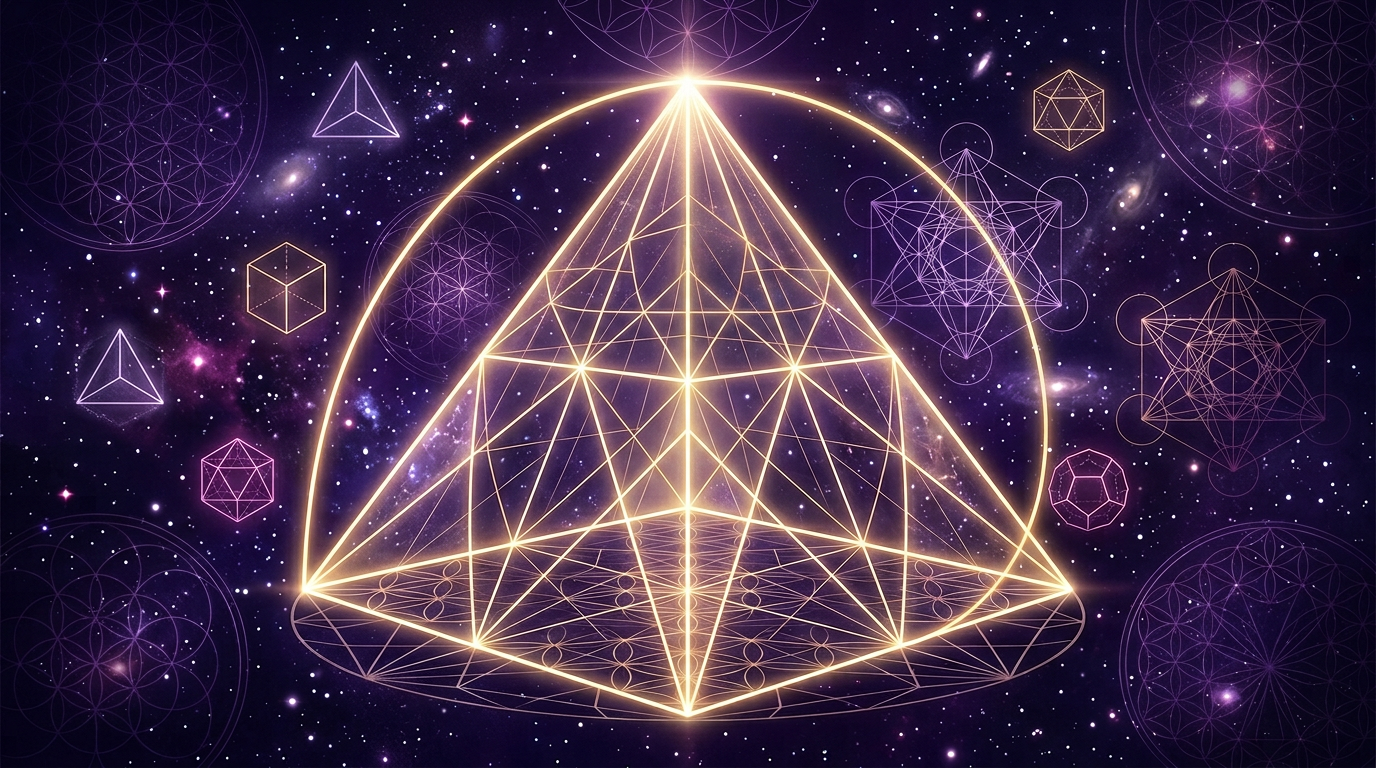
The five Platonic solids (tetrahedron, cube, octahedron, dodecahedron, and icosahedron) are the building blocks of sacred geometry. These are the only five shapes where every face is identical and every angle is equal. In many spiritual traditions, each solid corresponds to an element: earth, fire, water, air, and the fifth, sometimes called aether or spirit.
Sacred Geometry in Ancient Architecture
Cultures across the globe encoded sacred geometric principles into their most important structures. The Parthenon incorporates the Golden Ratio in its facade proportions. Gothic cathedrals use the Vesica Piscis in their arched windows. Islamic mosques feature intricate tessellations based on geometric harmony. Hindu temples are built on mandala-derived floor plans.
And then there are the pyramids.
The Pyramid Shape in Energy Healing
Why Pyramids? The Geometry of Focus
Pyramid structures appear independently across civilizations that had no known contact with one another. Egypt's Great Pyramid at Giza (~2560 BCE), Mesoamerican pyramids at Teotihuacan and Chichen Itza, the Nubian pyramids of Sudan, the stepped pyramids of Southeast Asia, and the burial mounds of China all share this fundamental shape.
The convergence is striking. And in sacred geometry traditions, it's not considered coincidental.
The pyramid is closely related to the tetrahedron, the simplest Platonic solid, a four-faced structure that represents the most basic stable form in three dimensions. Where the tetrahedron is pure geometry, the pyramid as built by humans adds a flat base, creating a structure that is both grounded and ascending.
Practitioners interpret this shape as a tool for focus. A wide base collects energy from a broad area. The four triangular faces channel that energy inward and upward. The apex concentrates it to a single point. The geometry itself creates a pathway from dispersed to directed.
Base, Sides, and Apex: How Practitioners Understand the Shape
In energy healing traditions, each element of the pyramid carries symbolic and functional meaning.
The base represents the earthly, the grounded, the material plane. It's the foundation that connects the pyramid (and whatever is placed within it) to the physical world.
The sides are the pathway, the transition from broad to narrow, from many to one. Some practitioners draw parallels to the chakra system: the ascending structure mirrors the energetic column from root to crown.
The apex is the point of unity, transcendence, and concentrated energy. In practice, this is where many practitioners observe the strongest energetic effects. Objects placed beneath the apex, or crystals positioned at the peak of an orgonite pyramid, are considered to be in the shape's most active zone.
The Great Pyramid of Giza is often cited as encoding the Golden Ratio in its proportions. The ratio of its slant height to half its base length approximates phi (1.618). Whether this was intentional or an elegant coincidence remains debated among historians. Either way, the proportions have become a benchmark for energy practitioners who build pyramid-shaped tools.
Pyramid Power: A Brief History
The modern fascination with "pyramid power" traces through three key figures.
Antoine Bovis (1930s). A French ironmonger who visited the Great Pyramid and claimed that animal remains inside the structure mummified rather than decaying normally. He built scale-model pyramids at home and reported similar preservation effects. Bovis's observations were anecdotal, not verified by controlled experiments, but they sparked a chain of investigation that continues today.
Karel Drbal (1949). A Czechoslovak engineer who patented a pyramid-shaped razor blade sharpener (Czech Patent No. 91304, granted 1959). He claimed the pyramid shape maintained blade edges over time. The story goes that the patent examiner built his own model and tested it before approving the application.
Patrick Flanagan (1970s). His book Pyramid Power (1973) brought the concept to a mainstream audience. Flanagan claimed pyramids could preserve food, enhance meditation, improve sleep, and sharpen blades. The 1970s saw a full "pyramid power" cultural moment, with pyramid-shaped meditation frames, sleep canopies, and charging platforms entering the wellness market.
It's worth being transparent here: mainstream science has not verified pyramid power claims. Controlled experiments have not reliably replicated the preservation, sharpening, or energy effects that proponents describe. What we have is a long, cross-cultural tradition of people experiencing something meaningful about this shape, and a body of anecdotal evidence that, while not scientific proof, is too consistent to dismiss without curiosity.
The Grounded Mystic approach: honor the tradition. Be honest about the science. Stay curious.
Sacred Geometry and Orgonite Pyramids
How Shape, Crystal, and Metal Work Together
Orgonite combines three elements: organic resin, inorganic metal, and quartz crystal. When cast in a pyramid shape, practitioners believe the geometry amplifies the matrix's effect.
Here's how the thinking goes: the resin and metal create a continuous push-pull dynamic with ambient energy (resin attracting, metal repelling). The quartz, under constant gentle pressure from the curing resin, generates a subtle piezoelectric charge. And the pyramid shape focuses and directs whatever the matrix produces.
It's a layered system. The materials do their work. The shape gives it direction. This is why most orgonite is pyramid-shaped, even though the same materials can be cast in any form. Many practitioners also value the pyramid for its role in EMF harmonization, placing orgonite pyramids near electronics as part of a broader energy-aware practice.
Why Most Orgonite Is Pyramid-Shaped
While orgonite exists in pendants, discs, cones, and other forms, the pyramid remains the most popular shape by a wide margin. Practitioners report the strongest and most consistent effects from pyramid-form orgonite, and sacred geometry offers the framework for understanding why: the pyramid's inherent geometry of convergence takes the orgonite matrix's energy-processing properties and concentrates them.
Michelle's handcrafted orgonite pyramids are made with this understanding. Each piece is intentionally shaped, with crystals selected and positioned based on both healing tradition and the sacred geometry of the form itself. The same principles apply to larger orgone-based devices like cloud busters, which use pipe-in-orgonite construction that still relies on the relationship between shape and material.
Other Sacred Geometry Shapes in Energy Work
The pyramid isn't the only sacred geometric form practitioners use. Three others appear frequently.
The Merkaba (Star Tetrahedron)
Two interlocking tetrahedra, one pointing up and one pointing down, forming a three-dimensional Star of David. In Kabbalistic and Egyptian traditions, the Merkaba represents the union of opposing forces: masculine and feminine, heaven and earth, spirit and matter. Meditation practitioners use Merkaba visualizations for spiritual protection and expanded awareness. Merkaba-shaped crystals and orgonite are popular meditation tools.
The Flower of Life
A pattern of overlapping circles arranged in a hexagonal grid, creating a flower-like design that contains within it the templates for all five Platonic solids. Found carved in the Temple of Osiris at Abydos, in Chinese temples, and in Renaissance art (Leonardo da Vinci studied it extensively). Practitioners use Flower of Life patterns as crystal grid templates, meditation focal points, and energetic blueprints for harmonizing spaces.
Metatron's Cube
Derived from the Flower of Life, Metatron's Cube is a complex figure containing all five Platonic solids within its geometry. Named for the archangel Metatron in Jewish mystical tradition, it's considered a map of creation itself. Energy practitioners use it as a meditation tool for understanding the interconnection of all forms and for clearing dense or stagnant energy.
Bringing Sacred Geometry Into Your Practice
Pyramid Placement and Intention Setting
If you work with an orgonite pyramid or crystal pyramid, placement and intention amplify the practice. Many practitioners position their pyramid in a space where they want to focus energy: a meditation corner, a workspace, a sleeping area.
Intention setting is simple. Hold the pyramid, set a clear intention for what you'd like the tool to support, and place it in your chosen spot. Some practitioners align the base sides with the cardinal directions. Others let intuition guide placement. There's no wrong approach.
Creating a Sacred Geometry Grid
Crystal grids use sacred geometry patterns as templates for arranging healing crystals in intentional formations. A common beginner grid places a master crystal (often clear quartz) at the center of a Flower of Life pattern, with supporting stones at each intersection point.
The geometry provides structure. Your intention provides direction. Together, they create what practitioners describe as an energetic field greater than the sum of its parts.
For practitioners who also work with sound healing tools like tuning forks, combining vibrational frequency work with sacred geometry grids is a natural extension. Geometry and vibration share the same root: patterns that repeat at every scale of the natural world. And if you're interested in the hands-on side of building geometric tools from copper, learning to solder opens up a world of custom creations.
The Shape Is the Starting Point
Sacred geometry is one of those subjects that deepens the longer you stay with it. What begins as curiosity about a shape can open into a lifelong study of pattern, proportion, and the hidden architecture of the natural world.
The pyramid is a beautiful entry point. It's tangible. You can hold one. You can sit with it during meditation and notice what shifts. You can place one on your desk and observe, over days and weeks, whether the space feels different.
Science may not have verified pyramid power. But thousands of years of human attention to this shape, across every inhabited continent, suggests something worth exploring with an open mind.
Start with the shape. See where it leads you.
Explore handcrafted orgonite pyramids made with intention and sacred geometry in mind.
Curious about the tools and materials inside? Read What Is Orgonite? A Beginner's Guide
Learn more about the energy healer behind The Northern Daisy
