For centuries, people have used simple tools to detect what they cannot see: underground water, minerals, ley lines, energy fields. A forked branch. Two pieces of bent wire. A crystal on a chain. Dowsing, also called divining or water witching, is one of the oldest and most accessible practices in the energy healing tradition.
Today, dowsing rods have found a second life beyond well digging. Energy practitioners use them to read the energetic landscape of a space, locate areas of disturbance or concentration, and guide the placement of orgonite pyramids, healing crystals, and other energy tools. The practice requires no batteries, no software, no certification. Just a pair of rods and your own attention.
This guide walks you through what dowsing is, the three main types of dowsing tools, how to build and use L-rods, and how practitioners integrate dowsing with EMF protection work, crystal healing, and other modalities. We'll also be transparent about what science has and hasn't validated. The Grounded Mystic approach: honor the tradition, be honest about the evidence, stay curious.
What Is Dowsing? A History Older Than You'd Think
References to dowsing date back at least to 15th-century Germany, where it was used in mining operations to locate ore deposits. Some historians suggest even older origins. The practice crossed the Atlantic with European settlers and became a tradition in rural America, particularly for locating well sites. To this day, some well drillers and utility workers use dowsing as part of their process, alongside modern detection equipment.
In energy healing, dowsing rods have evolved into tools for mapping invisible landscapes. Practitioners use them to identify ley lines, earth energy grids, and areas of energetic disturbance before clearing or grid work. The underlying idea is consistent across centuries: the dowser acts as a conduit. The tools don't generate or detect energy on their own. Rather, they respond to the subtle movements of the person holding them, movements that practitioners believe are guided by the body's sensitivity to whatever is being sought.
A word of transparency: controlled scientific studies have not demonstrated that dowsing performs better than chance at locating water or other targets. A notable 1986 German government study initially appeared to support dowsing but was later reanalyzed and found inconclusive. Despite this, the practice remains widespread among energy healers, rural communities, and some professional water finders. We present it here as a time-honored practice worth exploring with an open mind, not as a scientifically verified technique.
The Three Types of Dowsing Tools
Dowsing takes three main forms. Each has its own history and best uses.
L-Rods (Metal Wire Rods)
The most common beginner-friendly type. Two L-shaped pieces of metal wire (copper or steel), held loosely in each hand so they can swing freely. When the dowser walks over a target (water, energy line, or area of interest), the rods are said to cross, open wide, or swing to one side. L-rods are the standard for energy healing practitioners because they're easy to make, easy to use, and responsive to subtle movements.
Copper is the most popular material among energy practitioners. The same properties that make copper valued in energy tool making, its high conductivity and traditional association with energy flow, make it a natural choice. Steel rods (made from coat hangers) work well for beginners and cost almost nothing. Many practitioners find that copper rods feel more responsive over time.
Y-Rods (Forked Branches)
The traditional dowsing tool. A naturally Y-shaped branch, typically from willow, hazel, witch hazel, or peach trees. Held by the two forks with the stem pointing forward. The rod supposedly dips or twitches over the target. Y-rods are free if you have access to the right trees. Light, porous woods are preferred. They require no construction, only selection.
Y-rods are less common in modern energy healing circles, but they connect you to the oldest form of the practice. If you're drawn to traditional methods, a forked branch is a beautiful place to start.
Pendulums
A weighted object (crystal point, metal bob) on a string or chain. Held still and observed for directional swings. Not technically a "rod," but part of the same dowsing tradition. Pendulums are used for yes/no questions, personal inquiry, and decision-making. They're excellent for indoor work, desk-based practice, and situations where walking with rods isn't practical.
Many practitioners use both rods and pendulums: rods for mapping space, pendulums for asking questions.
How to Build Your Own L-Rods
You can buy copper dowsing rods, but making your own is simple and costs under $10.
Materials:
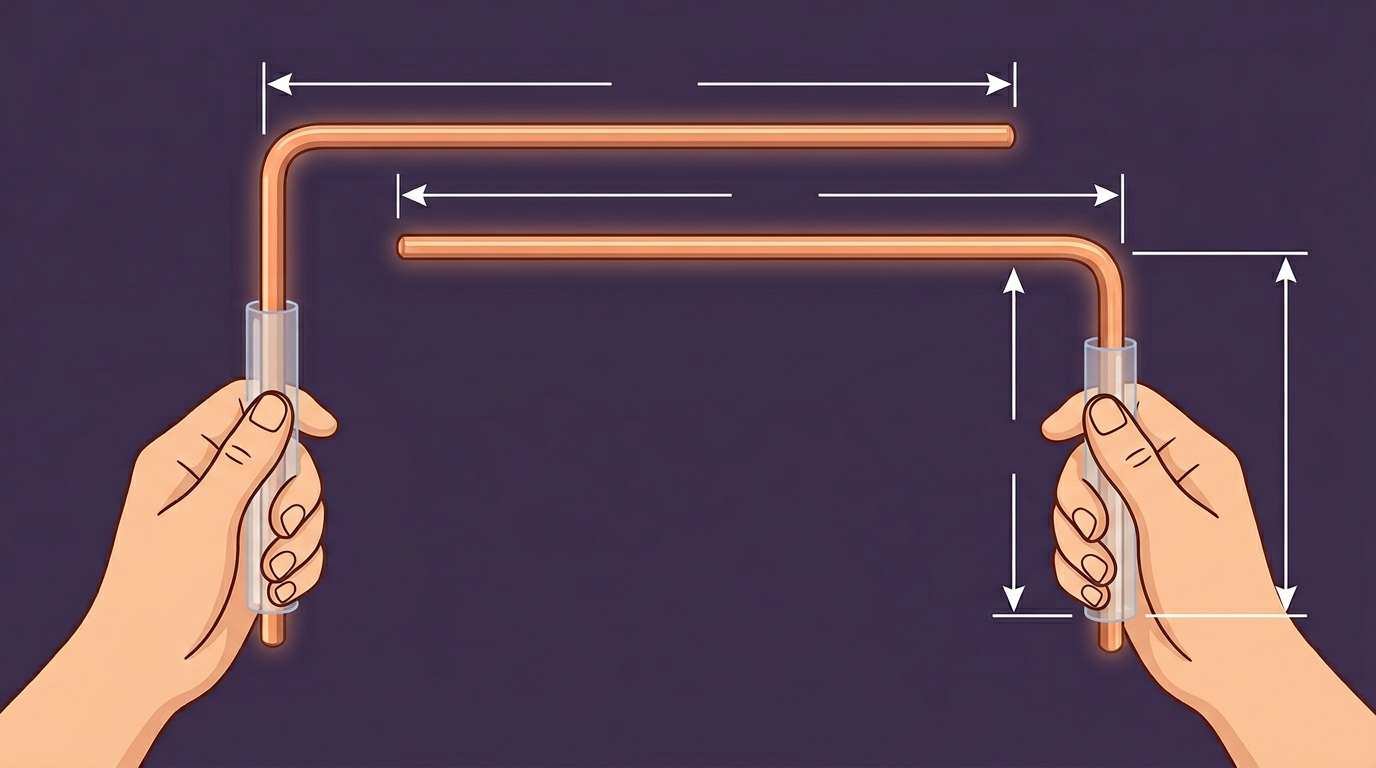
- 2 pieces of copper wire or straightened coat hangers, each about 18 inches long
- Wire cutters
- Optional: 2 plastic straws or pen tubes (to slide over the handle so the rod swings freely)
Steps:
- Cut two pieces of wire to 18 inches each.
- Bend the last 6 inches of each piece at a 90-degree angle to form the handle. The long section points forward; the short section becomes the grip.
- Optionally, slide a plastic straw or pen tube over the handle section. This allows the rod to rotate freely in your hand without friction. Some practitioners prefer bare wire. Try both.
- Your L-rods are ready. Hold them loosely and walk.
How to Use Dowsing Rods: A 7-Step Getting-Started Guide
If you're trying dowsing rods for the first time, follow this process.
- Make or acquire your L-rods. Cut two pieces of copper wire (or straightened coat hangers) to about 18 inches each. Bend the last 6 inches at a 90-degree angle to form the handle. Optionally, slide a plastic straw or pen tube over the handle so the rod swings freely. Total cost: under $10.
- Hold the rods loosely. One in each hand, handles pointing up, long ends pointing forward. Your grip should be relaxed enough that the rods can swing without resistance, but firm enough to keep them from falling. Tension blocks subtle movement.
- Set your intention. Before you start walking, decide what you're looking for. Water? An energy line? A spot for your orgonite? Clarity of intention matters in dowsing. Practitioners believe that a clear question yields a clearer response.
- Walk slowly and deliberately. Move through the space at a calm, even pace. Rushing misses subtle signals. Keep your arms steady at your sides, elbows bent, rods parallel and pointing forward.
- Watch for movement. When you pass over the target (or an area of energetic interest), the rods may cross, open wide, or swing to one side. The response varies by practitioner and intention. There's no single "correct" response. Notice what your rods do.
- Practice in known locations first. Walk over a known water pipe, a garden hose, or a spot where you've previously felt energetic activity. This helps you calibrate your sensitivity before exploring unknown areas. Calibration builds confidence.
- Stay patient. Responses are often subtle, especially in the beginning. Don't expect dramatic swinging. A gentle, persistent pull in one direction is more common than rods snapping shut. Give yourself time to develop sensitivity.
Common Dowsing Applications in Energy Work
Beyond water finding, energy practitioners use dowsing for:
- Space clearing preparation. Dowsing a room before (and after) clearing with sage, sound, or crystal work to identify and verify energetic shifts.
- Garden planning. Some gardeners dowse to find the most energetically favorable spots for planting.
- Tool placement. Using rods to determine where an orgonite pyramid or crystal cluster will have the strongest beneficial effect in a room.
- Ley lines and earth energy. Mapping the energetic grid of a property or space.
- Personal inquiry. Pendulum dowsing (a weighted crystal on a chain) is commonly used for yes/no questions and personal reflection.
Dowsing and Other Energy Practices
Dowsing integrates naturally with other modalities. Use it alongside crystal healing to guide grid placement. Pair it with orgonite work to find the best locations for your pyramids. Combine it with cloud busters and other environmental energy tools to map the landscape before and after large-scale clearing. Some practitioners dowse to identify EMF hotspots before placing harmonizing tools.
The beauty of dowsing is its simplicity. Two pieces of wire and your own sensitivity. No batteries, no software, no certification required. It's one of the most accessible entries into hands-on energy work.
Tips for Better Dowsing
Avoid gripping too tightly. This is the most common beginner mistake. A death grip prevents the rods from moving. Hold them like you're carrying a delicate bird: firm enough to keep them, loose enough to let them respond.
Walk slowly. Subtle signals need slow, deliberate pacing. If you're not getting responses, slow down. Way down.
Don't expect Hollywood drama. Responses are often gentle. A slight pull. A gradual crossing. The more you practice, the more you'll notice.
Ground yourself first. Many practitioners take a few breaths, set their feet, and consciously release tension before starting. A calm body supports subtle perception.
Trust your calibration. If you've practiced over known water or energy lines and gotten consistent responses, trust that your rods are working. The "is this real?" doubt can block sensitivity. Practice builds evidence.
The Northern Daisy's Approach to Dowsing
Michelle Nast, the energy healer behind The Northern Daisy, works with energy in many forms. Dowsing is one of the tools in her practice. She uses it to map spaces, guide orgonite placement, and support the kind of intentional energy work that defines The Northern Daisy.
Whether you're curious about dowsing for the first time or you've been practicing for years, the invitation is the same: pick up a pair of rods, set a clear intention, and walk. The practice has survived centuries for a reason. What you discover is yours to explore.
Explore handcrafted orgonite pyramids to place with intention in your space.
Curious about other energy tools? Read Cloud Busters: What They Are and How to Build One
Want to learn the copper craft behind energy tools? Read Copper Soldering for Beginners